
Heritage Path of the Month.
Greenock Cut is our Heritage Path of the Month for April 2026.
More about the Greenock Cut:
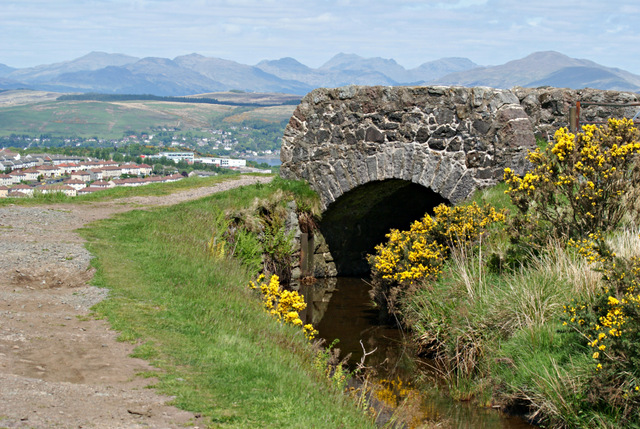
The Greenock Cut is a former aqueduct with embankment serving as a walkway. It follows the contours of the hillside, mainly overlooking the town and the magnificent scenery of the Firth of Clyde and beyond to the Argyll hills and the “Arrochar Alps”.
Our route description starts at Overton, as this is more easily accessed by public transport. From the steep Overton Road car park, a fine gravel ramp leads up to the aqueduct. An openable metal kissing gate provides access to the embankment eastwards. The surface is basically grass grown hardcore/gravel wide enough for two to walk abreast. Follow the Cut all the way to Shielhill farm (NS241721), where the road is crossed before following the path to Cornalees Bridge and the Greenock Cut Visitor Centre where there are toilets, a cafe, and picnic facilities.
From here, there are two good alternatives to heading back the same way. Either take the Waterman’s Road, which is a path creating a more direct, if significantly less-level, route back to Overton – it is recommended to do this combined circular walk anti-clockwise to enjoy the scenery. Or continue to Wemyss Bay, using the Kelly Cut.
The visitor centre website’s downloadable walk leaflet is recommended, as it provides additional historic and natural heritage information.
OS Landranger 63 (Firth of Clyde area)
The Greenock Cut is an aqueduct built between 1825 and 1827 to supply water from Loch Thom to the mills and population of Greenock. It was built by Robert Thom, after whom the expanded Loch was re-named, and is a very early example of its type. The visitor centre has an interactive Greenock Cut exhibition that explains Thom’s 1820’s engineering. In 1971, the aqueduct was superseded by the Loch Thom Tunnel; the following year it was designated as a Scheduled Monument.
More about Heritage Paths
Learn about the history of some of the oldest transport routes in Scotland. Heritage Paths records the history of over 400 routes that criss-cross the Scottish landscape. From Roman Roads to Military Roads, find out how the route you are following came into being.
As well as historical information, you’ll find a modern-day route description along with start and finish details. Change the background mapping in our interactive viewer and time travel along your favourite Heritage Path from 1843 to today.
Photo by © Thomas Nugent, Geograph