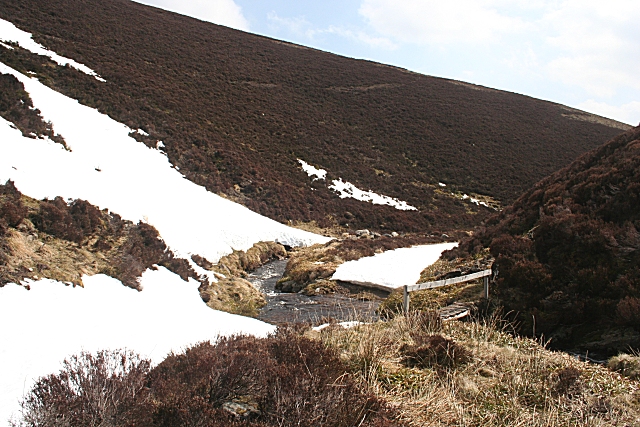
Kindie Burn Path Show path on map
Start location: A97, Glenkindie ( NJ 427 142 )
End location: west of bridge over Allt Deveron, Cabrach ( NJ 384 267 )
Geographical area: Grampian
Path type: Rural Path
Path distance: 11km
Accessibility info: Suitable for pedestrians
Route Description
Leave the A97 in Donside 1km west of Glenkindie and go north on the minor road up the Kindie Burn by Glencuie and Rinmore to Largue, where the road ends. Then go north-northwest by a track which ends ½km south of the col between Dun Mount and Mount Meddin. Go north across this col over very rough ground – peat bog and heather – to find the end of the track on the north side of the watershed. Accurate navigation is necessary. This track descends to the east of north-flowing Kindy Burn, crossing a ford to reach Bracklach. This ford may be difficult in spate, so if necessary can be avoided by a minor diversion at NJ390238 via Bodiebae to reach Powneed (see alternative route below).
From Bracklach, the old route went north-northwest, but may now be wet and hard to find – it meets the Road to Glenbuchat at NJ379262 , just south of Whitehillock, then heads northeast to reach the public road at NJ384267, just west of the bridge over the Allt Deveron. Alternatively from Bracklach, and more straightforwardly, head north-northeast to Powneed, from where a farm road goes to Cabrach at NJ389268.
Heritage Information
This old route is shown on the OS 6 inch to the mile map, surveyed in the 1860s. The sites of Chapel Ronald and St Ronald's Well between Glencuie (NJ424167) and the Kindie Burn are also shown, although both chapel and well were already ruined at the time the OS maps were surveyed.
This track was certainly used by people travelling to and from the Cabrach area to Donside, but the existence of Chapel Ronald perhaps points to another use of the path. It may well have been used by people to attend services and burials, so could have been a Kirk road and coffin road as well. The placenames Hillock of Cross and Burn of Cross may also indicate a religious use. We know very little about Chapel Ronald; it is said by some to have been named after Rognvald, the 12th century Earl of Orkney who initiated the building of St Magnus Cathedral, but it has also been argued that St Ronald is a corruption of the more likely St Ronan.