Howden Glen path Show path on map
Start location: car park south of A720, Dreghorn ( NT 228 680 )
End location: Castlelaw, north of Penicuik ( NT 229 637 )
Geographical area: Lothian and Borders
Path type: Leisure Path
Path distance: 4.8km
Accessibility info: Suitable for pedestrians
Route Description
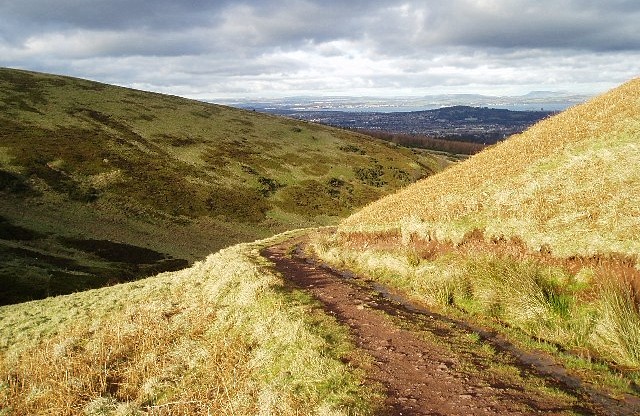
This path ascends Howden Glen, crosses the pass between Allermuir Hill and Capelaw Hill and continues south over Fala Knowe, then downhill across the east side of Castlelaw Hill. The route continues past a prehistoric fort and souterrain to reach Castlelaw farm where there is a small car park.
The Ministry of Defence own much of the land covered by this path, and have a firing range south of Castlelaw Hill. When red flags are flying (red lights at night) walkers are not allowed into the area marked ‘Danger Zone’ on maps.
OS Landranger 66 (Edinburgh & Midlothian area)
Heritage Information
This route has a controversial history. Claim and counter-claim were made in the 1880s about the right of way status of the path through Howden Glen. However, it appears from Will Grant's book "Pentland Days and Country Ways" that the division of the Commonty of Pentland Hills in 1709 caused an earlier series of disputes as to the status of affected routes. He writes that the inhabitants commissioned "a horseman to ride through the Loan and over the path through the Howden Glen annually to preserve the right-of-way". This tactic would not necessarily produce the desired result, so if anyone knows further detail about this aspect of the case, we'd be very pleased to hear more.
The nineteenth century court actions did not resolve the matter - there was a public outcry when the operation of the firing ranges impinged upon the route. Negotiation with the military authorities resulted in the continuation of public access, although it seems that the various parties had to agree to disagree about the status of the route. With occasional hiccups and spats along the way, public access continues to the present day.
Research continues as to the detail of all of the above, so if we find out more we'll add it here. If anyone already knows more about this evidently well-loved route's history, the Heritage Paths project would love to hear from them.