Bunavullin Coffin Road Show path on map
Start location: Bunavullin (—)
End location: Laudale, Loch Sunart ( NM 756 598 )
Geographical area: Lochaber
Path type: Coffin Road
Path distance: 36km
Accessibility info: Suitable for pedestrians, Survey required
Route Description
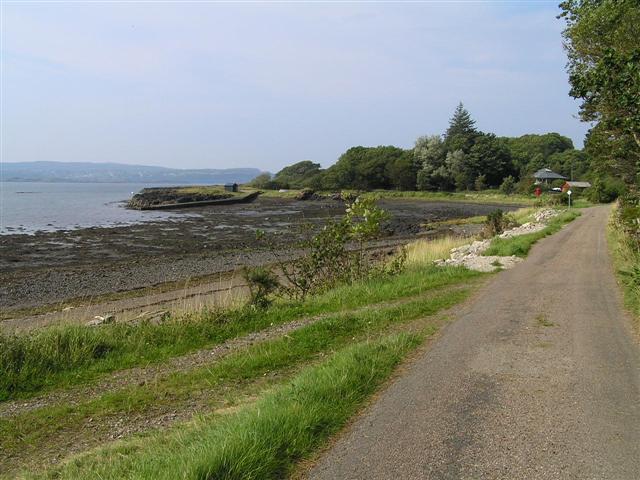
From Bunavullin take the track northeast then south uphill to Mungosdail farm, passing very close to the house and continue through the forest for 1.5km. Just after crossing a burn, take a small path northeast from NM583533 to the edge of the forest at a gate (NM593542). In 1794, there were corn mills and a kiln at Mungosdail.
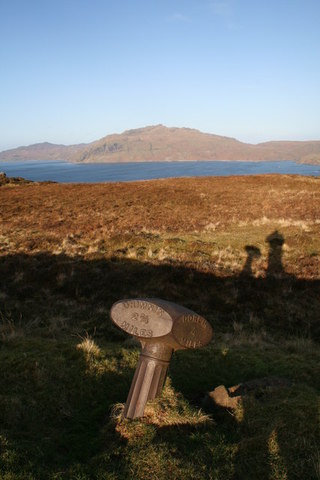
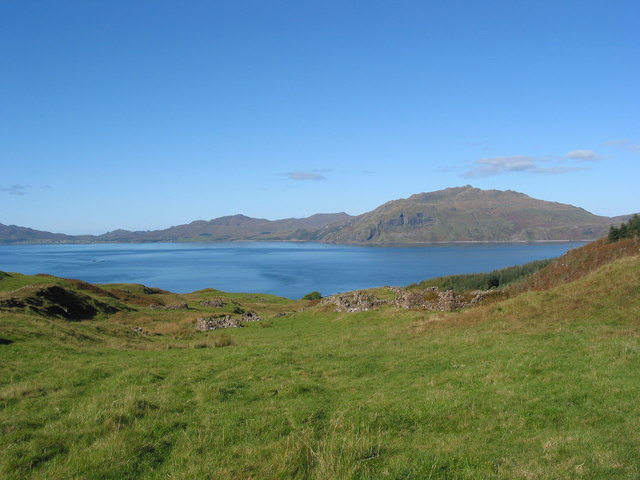
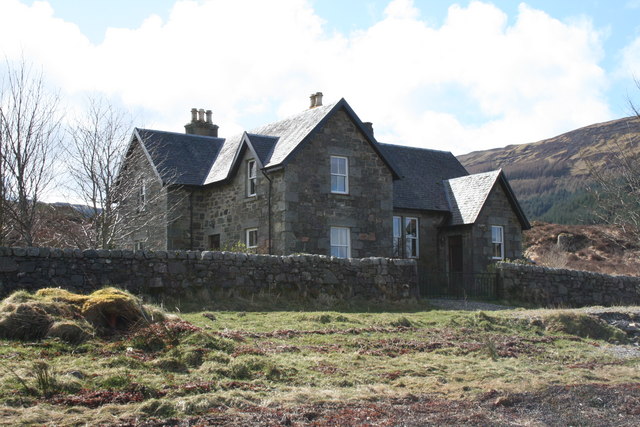
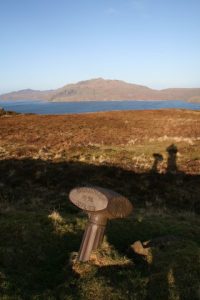
Continue northeast over the hill (no path) keeping to the east of Lochan Chrois Bheinn as far as NM601550, then over a stile into Barr Forest. Follow a path then a track to Ardantiobairt at the head of Loch Teacuis, where the school (no longer used) can be seen just short of the public road at Kinlochteacuis. From the Kinloch/Rahoy road junction (NM658547), take the track to the northwest around Loch Teacuis as far as NM646557 near Carnliath. Go east-northeast up the north side of the Allt an Inbhire by a waymarked route to the Bealach Sloc an Eich (pass of the hollow of the horses), to the west of Beinn Ghormaig (452m). Descend steeply through the forest to Glen Cripesdale, crossing a bridge over the Glencripesdale Burn at NM661592. Then follow the track east along the north side of the burn for 2km, leaving the burn to follow a path uphill through clear-felled forest, assisted by waymarkers, then along its northern edge to reach Lochan Dhonnachaidh (Duncan’s Loch) at a height of 300m. On the path, there are stone seats every 800m or so, possibly to allow the ladies of the house to rest while on their way to watch the men fishing. There are first class views to the west and north from the track near the lochan. The track then drops down through the forest to join the shore track at NM734603. Laudale House is passed to reach car parking at NM756598.
The part of this route from Drimnin to the Barr River is reportedly accessible by mountain bike, as is the nearby Heritage Path from Drimnin to Doirlinn.
OS Landranger 47 (Tobermory & North Mull) and 49 (Oban & East Mull)
Heritage Information
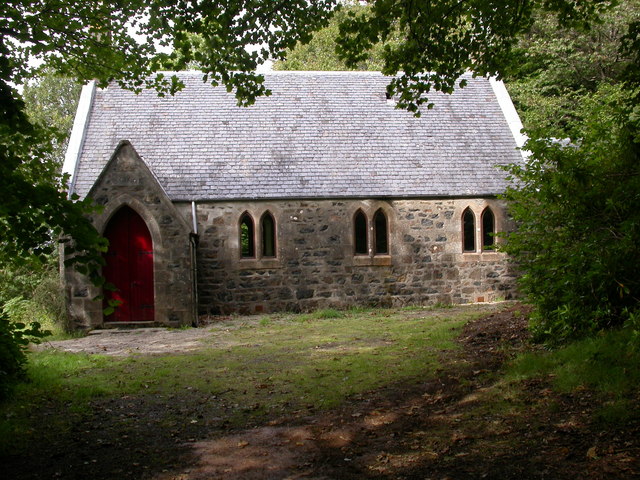
This route, and that from Doirlinn, are both reputed to have been coffin roads. The medieval parish church of Killlintag (Cill Leuntaig), dedicated to St Fintan, was located near Mungosdail just to the east of Bunavullin. The burial ground is still marked on current OS maps, but the church is reduced to its foundations. It was replaced in 1780 by a new building at Fernish to the south. This was itself superseded by the mission church built in 1892 for the western side of Morvern parish - this former Church of Scotland building can be seen in our picture gallery. Additionally, a Roman Catholic church, the Chapel of St Columba, was built in 1837 at Drimnin. However, the graves to the south of the chapel are modern.
The track from Ardantiobart to Bunavullin is clearly marked on all the OS mapping since the 6" first edition maps were surveyed in the 1870s. By the time of the OS 1" third edition map (surveyed 1905), a spur runs from the track (NM5853) down to Druim na Cracaig where the later Fernish churches were built.
St Columba's Stone (NM 5945 5428) provides evidence for the former use of the track from Loch Teacuis as a coffin or kirk road. It is said to have been one of a series of stones marking this hill track, and it lies on the highest point of the route giving its name to the hill to the north - Crois Bheinn (Cross Peak). The stone has a cross on each side and measures 0.61m by 0.51m. Its site is marked on the OS 1:25,000 Explorer map 383.
Further evidence for a series of stones marking the route has been found on a 1:10,000 map - two stones are marked near where the right of way leaves the forest before reaching St Columba's Stone, and another two are marked beside fords (NM591541 and NM585534) within the forest. This route between Drimnin and Barr is also said to have seen use as a post-track - the post being left beneath a rock at the pass between the forest and Coire Buidhe. So whether the stones in the forestry date from the track's use as a coffin route, or were placed to aid the postal service, we are not certain. Any photos or further information relating to the stones would be much appreciated.
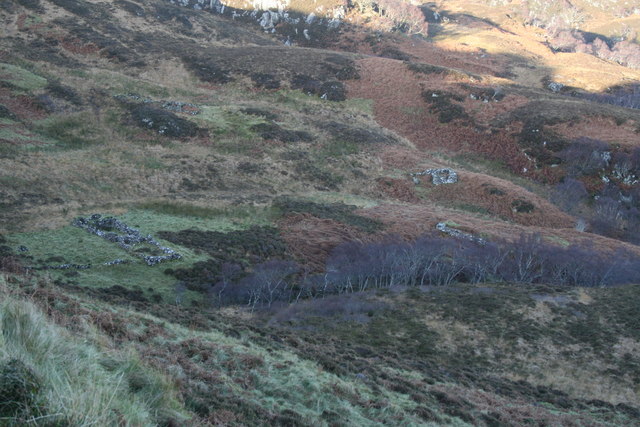
In 1824, Inniemore, Mungosdail, Barr and Ardantiobairt were purchased by Miss Christina Stewart of Edinburgh. She hardly ever visited the property and commenced the first large-scale evictions in Morvern, there being some 135 people living in these townships at that time. The following is the story of Mary Cameron of Aoineadh Mor (Inniemore):
"The day of flitting came... it was necessary to depart. The hissing of the fire on the flag of the hearth as they were drowning it reached my heart. We could not get even a bothy in the country, therefore we had nothing for it but the face the land of strangers (Lowlands). My mother-in-law was then alive, weak and lame, and was carried by my husband on his back. I followed with an infant at my breast and the other children. Our neighbours carried the little furniture that remained to us. We sat for a time on Knock nan Carn to take a last look at the place where we had been brought up: the houses were already stripped and the bleat of the ‘big sheep’ (Cheviots) was on the mountain".
In the 1990s, Inniemore came back to light as forestry felling took place. Beside the public road to Kinlochteacuis (Kinloch on 1:50k map) from the A884 is a car park (NM668517) with signposts and information boards; paths provide access to the remains of the township at NM656519.