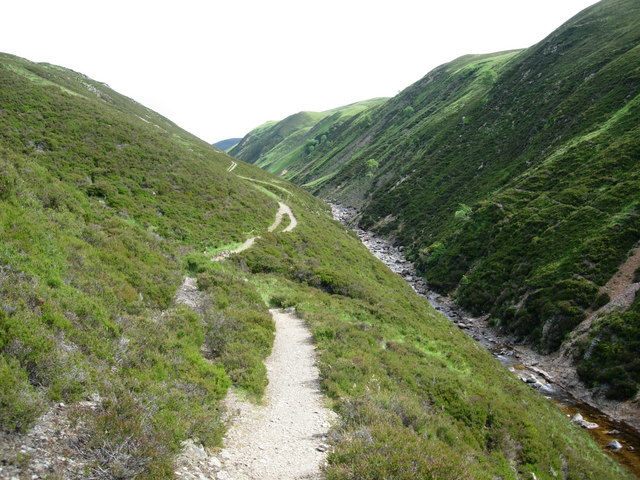
Glen Tilt Show path on map
Start location: Linn of Dee ( NO 061 897 )
End location: Fenderbridge, Blair Atholl ( NN 880 667 )
Geographical area: Cairngorms National Park, Perth, Kinross and Stirling (part)
Path type: Case Law, Drove Road
Path distance: 33.8km
Accessibility info: Suitable for bikes, Suitable for pedestrians
Route Description
This route starts at the Linn of Dee, but for those arriving there on foot from Braemar, to minimise road walking our surveyor recommends instead that paths through the Morrone Birkwood be followed to a conifer plantation at its west end which has stiles at entry and exit before meeting the public road just east of Corriemulzie. Walkers can then cross the Dee to Mar Lodge, then head to Linn of Dee having avoided the worst of any traffic.
From Linn of Dee to the Geldie Burn, a good estate track exists. At the Geldie Burn there is no longer any bridge. After this serious river crossing, a rougher track and footpath (avoiding further river crossings) leads to the ruins of Bynack Lodge. From there a track leads on for about 1km then becomes a footpath leading as far as the watershed. From there, a clear path leads to just south of the Bedford Memorial Bridge at the Falls of Tarf where a reasonable estate track is met. This continues to Auchgobhal where this old right of way rises out of the glen as a grassy track until Kincraigie farm from where a farm road and tarred public road lead to Blair Atholl.
This route is a serious undertaking with a potentially difficult remote river crossing near the north end.
The route is cycleable on good tracks except for the section between the Tarf and the Geldie where bikes will often have to be wheeled or carried. For a taster of part of the route, here’s Ben Dolphin’s video story of his bike ride from Blair Atholl to the Falls of Tarf and back again, with lots of history shared along the way.
OS Landranger 43 (Braemar & Blair Atholl)
Heritage Information
This old route is one of the great historical rights of way in Scotland. In 1847, a party of University of Edinburgh botany students led by John Hutton Balfour had an acrimonious encounter with the Duke of Athole and his ghillies, which became known as the Battle of Glen Tilt. This resulted in a lengthy legal battle between the Scottish Rights of Way Society and the Duke to establish the route's status, a dispute which ultimately went to the House of Lords and vindicated the right of way. It is likely that this case did more than any other to raise public awareness of rights of way; and it established that the Society could represent the public's interest.
In 1785, Glen Tilt had been the first of the key sites which evidenced geologist James Hutton's Plutonism theory and revolutionised our concept of time. Hutton's findings meant the glen was famous to scientists around the world. The behaviour of the Duke of Athole in denying public access led Hugh Miller to write in 1847: "There is scarce in the Kingdom a better-known piece of roadway than that which runs through the glen" and that "if the Scottish people yield up to his Grace their right of way through Glen Tilt, they will richly deserve to be shut out of their country altogether".
The route is said to have been a drove road. However, due to the narrowness of Glen Tilt, although it was used as such, other routes through the Cairngorms may well have been better suited to this type of traffic. Thomas Pennant's A Tour In Scotland 1769 is testament to this characteristic of the route, writing "The road is the most dangerous and the most horrible I ever travelled; a narrow path, so rugged that our horses often were obliged to cross their legs, in order to pick a secure place for their feet; while, at a considerable and precipitous depth beneath, roared a black torrent, rolling through a bed of rock, solid in every part but where the Tilt had worn its ancient way". Further on, passing a sheiling, Pennant drank goat whey by way of refreshment, then dined at Loch Tilt. However his description turns bleak once more as he travels onwards - with reference to "wild, black, moory melancholy tract" and "dreary wastes", he was evidently pleased to reach Braemar.
The Tarf Water is crossed just below the Falls of Tarf via the Bedford Memorial Bridge. On the bridge, a plaque reads: "This bridge was erected in 1886 with funds contributed by his friends and others and by The Scottish Rights of Way Society Ltd to commemorate the death of Francis John Bedford, aged 18, who was drowned near here on 25th August 1879". This young man had died trying to ford the Tarf. Queen Victoria did the same crossing in 1861 on a pony - those who led her steed had been almost up to their oxters in the water.
Glen Tilt's story continues to inspire. Ben Dolphin filmed a heartfelt short video Access All Areas about Glen Tilt's important part in the story of securing public access rights in Scotland. He reminds us all: "our access rights have been hard won, so please don't take them for granted!" Alex Roddie's The Atholl Expedition (2014) is a fiction set in the aftermath of the Battle of Glen Tilt. The story of public access to the Scottish outdoors was told in BBC Scotland's 2018 programme The Battle for Scotland's Countryside. This clip Stand-off on the Atholl Estate gives a taster, and keep an eye on the iPlayer for repeats. The programme's accompanying article rightly features Glen Tilt alongside the Jock's Road case as one of five key incidents in Scotland's struggle for public access rights.