Kirk Road to St Ninian’s Church Show path on map
Start location: Bigton ( HU 378 211 )
End location: St Ninian's Church ( HU 369 209 )
Geographical area: Shetland Islands
Path type: Rural Path
Path distance: 0.7km
Accessibility info: Suitable for pedestrians
Route Description
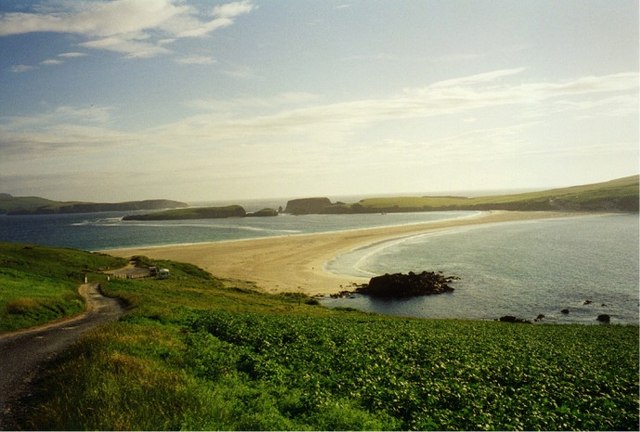
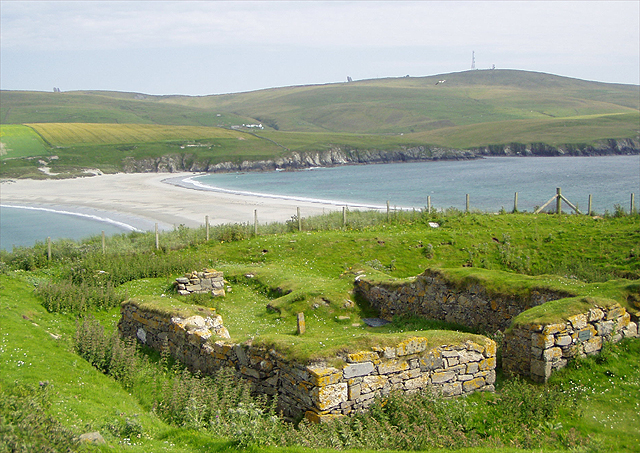
The path starts at a small car park at the end of an unclassified road from Bigton and makes its way down to the beach and across to St Ninian's Isle by a tombolo or ayre. This sand bar consists of white sand and it is usually possible to cross dry-shod to the island except in big storms. The path rises steeply from the tombolo through loose sand to reach the ruins of St Ninian's Church.
This route is promoted as one of Shetland's Peerie Wanders – local health walks developed by NHS Shetland and Shetland Islands Council. It also forms part of the St Ninian's Circular core path.
OS Landranger 4 (Shetland – South Mainland)
Heritage Information
St Ninian's Church was probably first built in about the 8th century AD. Excavations have shown though that the history of burial on St Ninian's Isle dates back to at least the Iron Age. The remains currently visible date to the 12th century and were in use until the Reformation, although it wasn't demolished until 1750. The island has been uninhabited since the late 18th century when peat supplies, essential as fuel, ran out. Although the church has been unused for hundreds of years, burials continued nearby until the mid 19th century. The national importance of this church site and burial ground have been recognised by their designation as a Scheduled Monument.
The church was the scene of a famous archaeological discovery in July 1958. Douglas Coutts, a schoolboy volunteer working with an Aberdeen University archaeological dig, discovered a hoard of Pictish silverware. It is thought it had been there since the late 8th or early 9th century, possibly hidden underneath the church to avoid them falling into the hands of Viking raiders.
A tombolo is a bar of sand or gravel connecting an island to the mainland, creating a tied island. There is tidal action on both sides of the bar, unlike with a sandspit and lagoon. The St Ninian's Isle tombolo is the largest in the UK and is one of Shetland's most famous beauty spots.