Via Regia Show path on map
Start location: unclassified road west of Auchnagallin ( NJ 048 338 )
End location: unclassified road south of Dunphail by bridge over River Divie ( NJ 026 461 )
Geographical area: Cairngorms National Park, Inverness, Nairn, Badenoch and Strathspey, Moray
Path type: Medieval Road
Path distance: 13.75km
Accessibility info: Suitable for pedestrians
Route Description
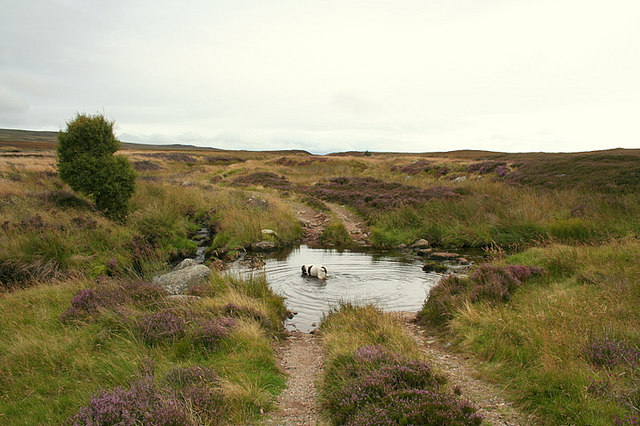
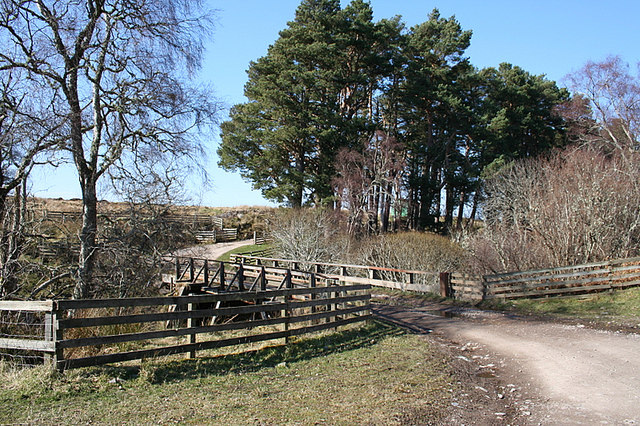
From Auchnagallin a good track runs by Badahad ruin to a shooting hut at NJ 047 382. At this point the older looking track by the Ourack Burn should be followed until it turns to the West at NJ 045 395 just after crossing the Ourack Burn ford. The old farm of Ourack is on the opposite bank on a dry raised area. From this point a rough section of track runs for about 200m and stops, beyond which there are some traces of footpath, and a short section of old road. However, it is largely a matter of finding a way along the W side of the burn, on the heathery bank through fairly boggy ground. The route is towards a conifer plantation where an old metal gate is found in the fence. Through this gate a track is followed in the trees but has numerous fallen branches on it. It emerges at Lynagowan, a ruin, and a modern track leads onwards to the River Divie ford. Once across this the track continues by Glenmore ruin and eventually takes a left turn down to Feakirk Bridge. From here a tarred road leads to Bantrach and the end of the route. However, a better walking route is to take a track on the right just before Bridge of Newton which follows the river down to Bridge of Bantrach. The parking space is just W of the bridge at a sharp bend in the road on the S side of the river.
OS Landranger sheet 27 (Nairn & Forres)
Heritage Information
This was a major 12th century route from Spey to Forres/Elgin.
The name Via Regia literally means King's Way and so would have been an incredibly important medieval road. It should be borne in mind that Via Regia is a type of road, much like an early Turnpike where the term Via Regia doesn't necessarily mean that the King walked the road but it shows the road is of a particularly good quality.