
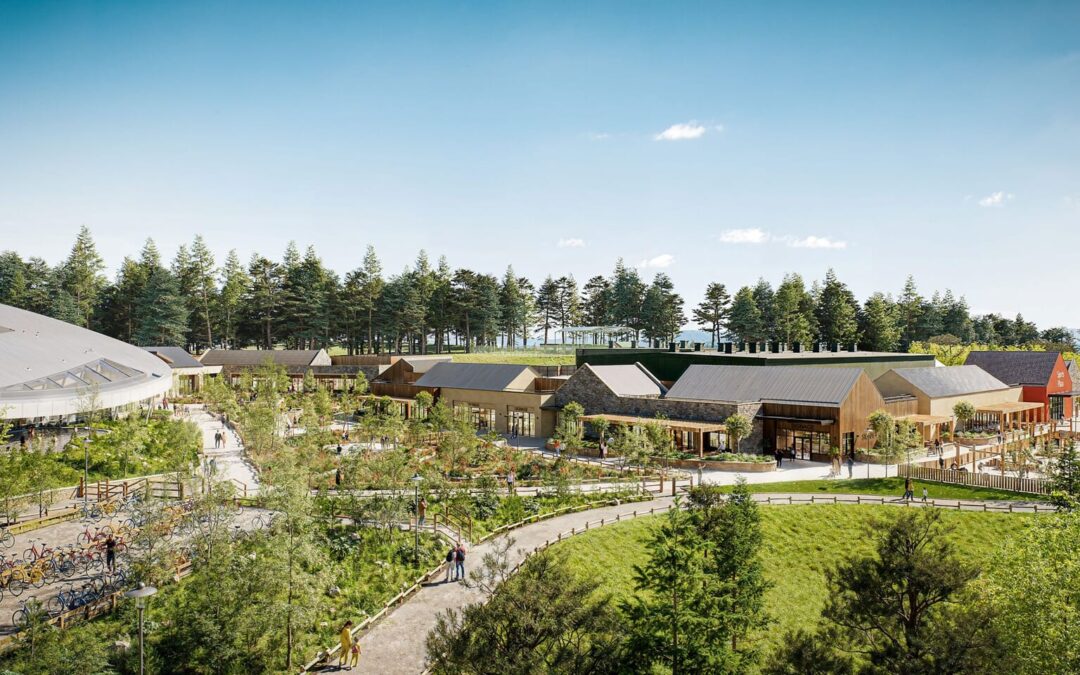
ScotWays continues to monitor the proposed Center Parcs holiday village near Hawick, in light of potential impacts upon access rights.
Firstly, an update to our previous news item about this development. On 8 December, the Planning and Building Standards Committee of Scottish Borders Council (SBC) granted planning permission for the Center Parcs development. The planning permission is subject to 41 conditions, including 2 requiring the submission for approval, prior to completion and occupation of the holiday village, and subsequent implementation of:
- (1) “a detailed path planning report covering non-vehicular access, long term management and enhancement of the right of way and core path network in the vicinity of the site” and arrangements for its future maintenance; and
- (2) “a detailed scheme of directional signage and information…in relation to rights of access, responsible outdoor access and wildlife legislation is made available on existing and proposed access paths”.
Whilst these conditions do not, in themselves, secure the path network improvements suggested in ScotWays letter of representation on the planning application, it is to be hoped the approved path planning report will require those improvements to be made.
On 11 September, SBC made byelaws under Section 12 of the Land Reform (Scotland) Act 2003 (the Act), exempting from the right of responsible access the eastern 214ha of the wider 405ha application site, on which it is proposed to site the enclosed holiday village (the Main Site). The byelaws were justified primarily on the grounds of the preservation of public order and safety, notably in the context of the Terrorism (Protection of Premises) Act 2025 (a.k.a Martyn’s Law), and the prevention of damage, danger or nuisance, all of which were considered necessary to secure the economic benefit it is estimated will accrue from the development and provide Center Parcs with certainty for its substantial investment.
SBC consulted ScotWays on the byelaws by letter of 22 October, the deadline for responses being 5 December. By law, byelaws must be submitted to the Scottish Ministers (the Ministers) for consideration of confirmation, and any objections to byelaws must be notified to them as the confirming authority. Accordingly, ScotWays notified the Ministers on 4 December that it objected to the byelaws and of its grounds for so doing. The objection letter was copied on the same date to SBC’s Legal and Licensing Service. Our objection related to the principle of making byelaws to exempt land from access rights, rather than specific concerns about the impact of the byelaws for public access over the Main Site. In essence, our grounds for objection were as follows:
- The case will be cited as a precedent to attempt to justify the exclusion of other holiday parks and visitor attractions across Scotland from access rights, thereby eroding access rights nationally;
- Byelaws should be limited to specific areas where a need has arisen, rather than on a precautionary basis, and should address a genuine and specific local problem. No specific problem associated with access currently exists on the Main Site, so the byelaws were made to prevent an anticipated problem should the development be approved. [In our view, the byelaws were premature and the making of them pre-judged the outcome of the proper consideration of the planning application];
- Alternative management tools should have been tried first, such as a rolling exemption order under S.11 of the Act. Guidance specifically indicates that byelaws are more applicable to managing/restricting certain activities, rather than excluding land itself from access rights as per S.11 orders.
- Center Parcs’ Martyn’s Law duties could be achieved without excluding land from access rights, if the enclosed fencing was combined with a requirement for persons to sign in/out and provide I.D. at the proposed Arrivals Lodge;
- Some of the reasons advanced to justify byelaws, such as risk of criminal activity or anti-social behaviour, are equally applicable to other areas of land across Scotland over which access rights are exercisable, so Center Parcs is not a special case in this regard;
- Economic benefit is not one of the criteria set out in the Act for justifying byelaws exempting land from access rights; and
- We doubt SBC has the resources to investigate breaches of, and seek to enforce, the byelaws.
It is the view of ScotWays that the way the byelaws have been framed is excessive in scope, so we suggest that if the byelaws are confirmed, the Ministers state clearly under which specific provisions of the Act they are being confirmed.
A report detailing the outcome of the byelaws consultation process was considered at a Special Meeting of SBC on 11 December. Having heard its Director of Corporate Governance summarise the content of the responses received to the consultation, including ScotWays objection, the Council agreed, after debate, to invite the Ministers to confirm the byelaws.
Before confirming the byelaws, the Ministers must take into consideration any objections received by them and may, if they consider it necessary or desirable, hold, or cause to be held, a local inquiry into the byelaws. Following appropriate consideration of the byelaws, the Ministers may confirm them with or without modification or refuse to confirm them and may fix the date on which the byelaws are to come into operation.
To be clear, ScotWays did not object to the Center Parcs planning application. Instead, we made positive suggestions regarding the protection and enhancement of public access in the wider area. In relation to the byelaws, we have objected, but solely in order to avoid inadvertently undermining the Land Reform (Scotland) Act 2003.
We shall update our News page when there is anything significant to report in respect of the byelaws or the development itself.
By Neil Feggans (Access Officer)